
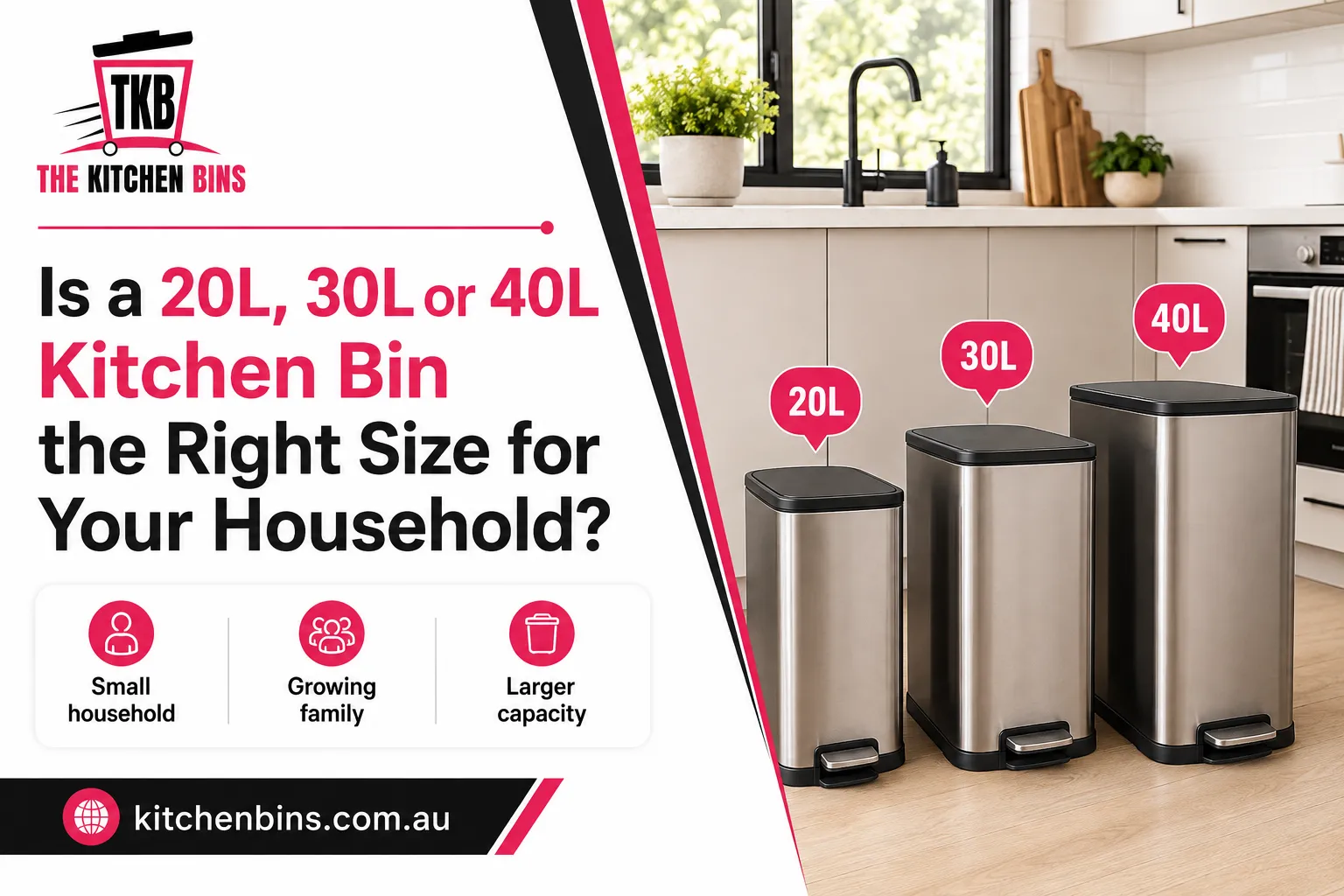
Kitchen-bin capacity sounds like a simple decision until cabinet dimensions, household size and recycling habits are added to the equation. A larger container reduces emptying frequency, but it also consumes more storage space and may allow waste to remain indoors longer.
For smaller households, a 20l bin can provide enough capacity without dominating a cabinet. Larger households may find that they need more volume.
Start With How Often You Empty Your Current Bin
Your existing routine provides useful information.
If a 20-litre container is emptied every evening and that schedule feels convenient, there may be little reason to increase capacity. If it fills by lunchtime, moving to a larger size could be more practical.
Rather than estimating, observe actual use for a week.
When a 20-Litre Size Makes Sense
A 20l bin may suit:
-
One- or two-person households
-
Kitchens with limited cabinet space
-
Households that empty rubbish frequently
-
Multi-bin recycling configurations
-
Secondary waste stations
-
Apartments with compact kitchens
The smaller footprint may also leave more room for another recycling container within the same cabinet.
Smaller Can Encourage Frequent Emptying
Capacity is not always about minimising trips outside.
Consider food-related waste
If rubbish contains food scraps, frequent emptying may be preferable. In this situation, a compact container can fit the household routine even when a larger bin would physically fit.
When to Consider a 30-Litre Bin
A 30l bin occupies a middle ground for households needing more capacity without moving immediately to a large container.
A 30l bin can work for moderate everyday waste where cabinet space allows. It may also suit households that separate recycling elsewhere and mainly need one general-waste container in the kitchen.
Physical dimensions should still be checked because two bins with similar stated capacity can have different height, depth or width.
When a 40-Litre Bin Can Be Useful
A 40l bin can suit families or kitchens that generate a greater volume of rubbish.
The additional capacity may reduce how frequently liners need to be changed, but a 40l bin also needs more cabinet space.
Before selecting one for an integrated system, ensure there is enough clearance to remove the bucket when full.
Household Size Is Only One Factor
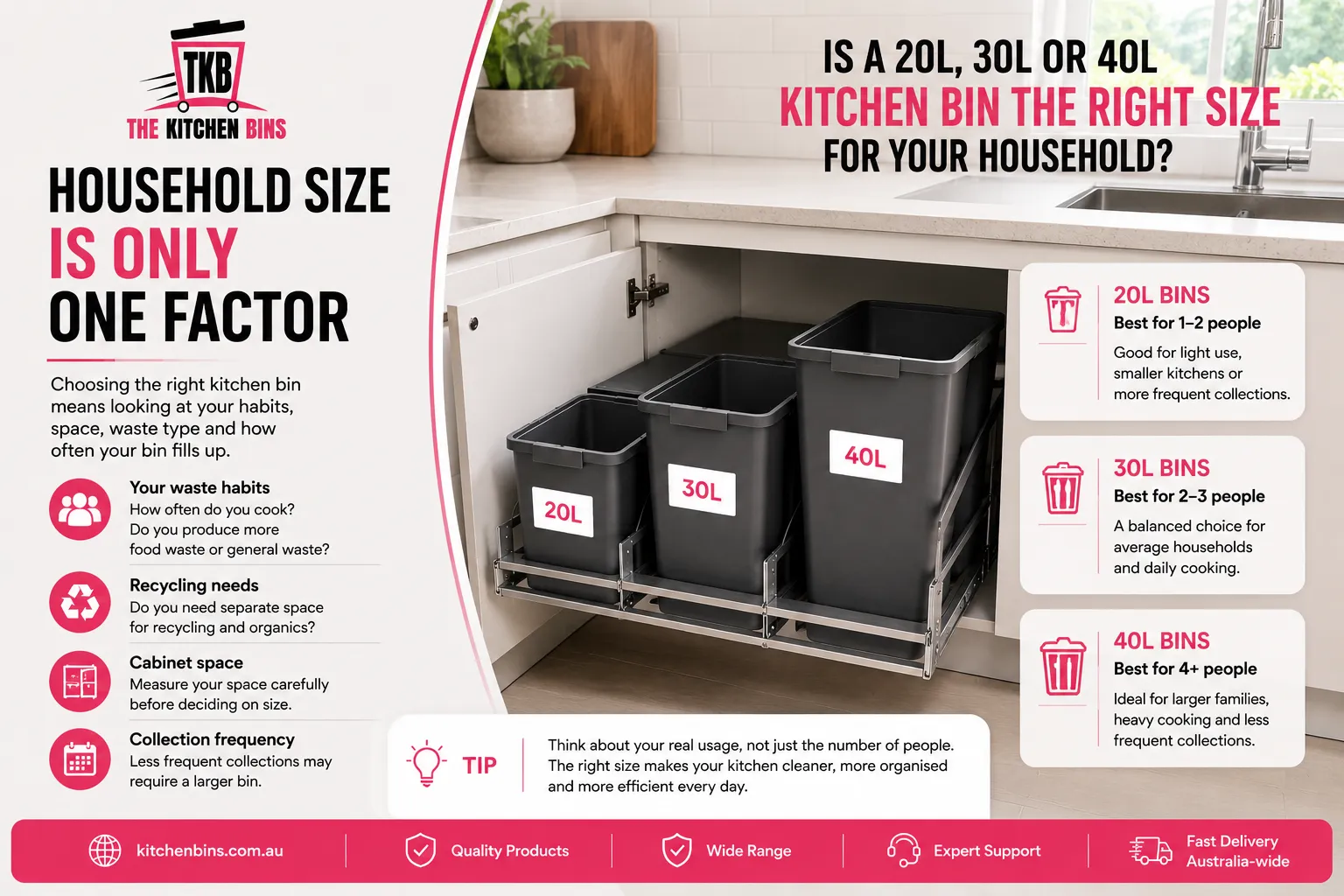
A family of four does not necessarily produce twice as much general waste as a household of two.
Recycling habits, meal preparation, packaging choices and collection schedules can change the required capacity considerably.
For example, a household that separates cardboard, containers and food scraps may need a relatively modest general-waste bin despite having several occupants.
Consider Multiple Smaller Containers
One large container is not always the most efficient use of space.
Two smaller bins can support separate waste streams while fitting within a similar cabinet footprint.
Compare the Total Capacity
Do not judge only by individual bucket size.
Think in terms of the complete system
Two 20-litre containers provide 40 litres of combined storage while allowing separation. Depending on household habits, that arrangement may be more useful than a single 40l bin.
Measure the Cabinet Carefully
For integrated products, capacity comes second to fit.
Measure internal width, depth and height. Check hinges, runners, plumbing and the amount of space needed to lift the container out.
A 30l bin that is tall and narrow may fit where a wider model with the same capacity does not.
Consider Liner Availability and Handling
Larger bins hold more waste, which also means a full liner may become heavier.
Think about who normally empties the bin and how far it needs to be carried. A slightly smaller size emptied more regularly may be easier for some households.
A 20l bin can therefore be a deliberate usability choice rather than a compromise.
Why Choose Us
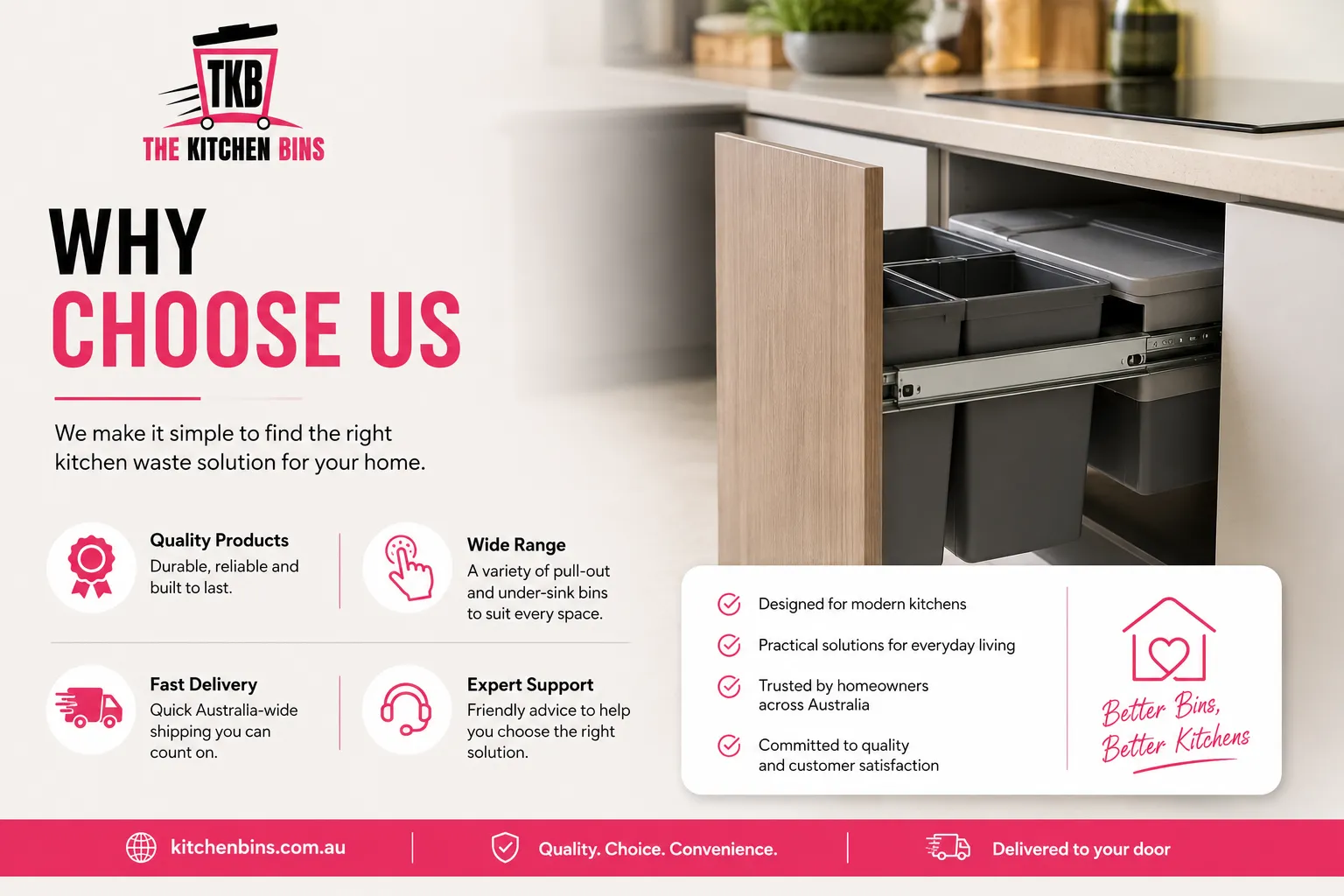
Kitchen Bins organises waste-storage products into practical categories that can help homeowners compare capacities against their available kitchen space. Shoppers can assess different size ranges while keeping cabinet fit and household routines in mind.
Capacity becomes more useful as a selection criterion when it is combined with accurate measurements rather than considered alone.
About Us
Kitchen Bins focuses on kitchen waste solutions intended for a variety of household and cabinetry requirements. The available collections help customers explore integrated options across different capacities.
For anyone deciding between 20, 30 and 40 litres, the right answer depends on both the available space and how quickly household rubbish actually accumulates.
Conclusion
A 20-litre bin can suit compact kitchens and frequent emptying. A 30-litre option offers a useful middle ground, while 40 litres can provide greater capacity for households producing more waste.
Observe your current routine, measure the cabinet and consider recycling separation. Those three checks give a much more reliable answer than selecting bin size from household headcount alone.
